The Planet Is Not a Vending Machine
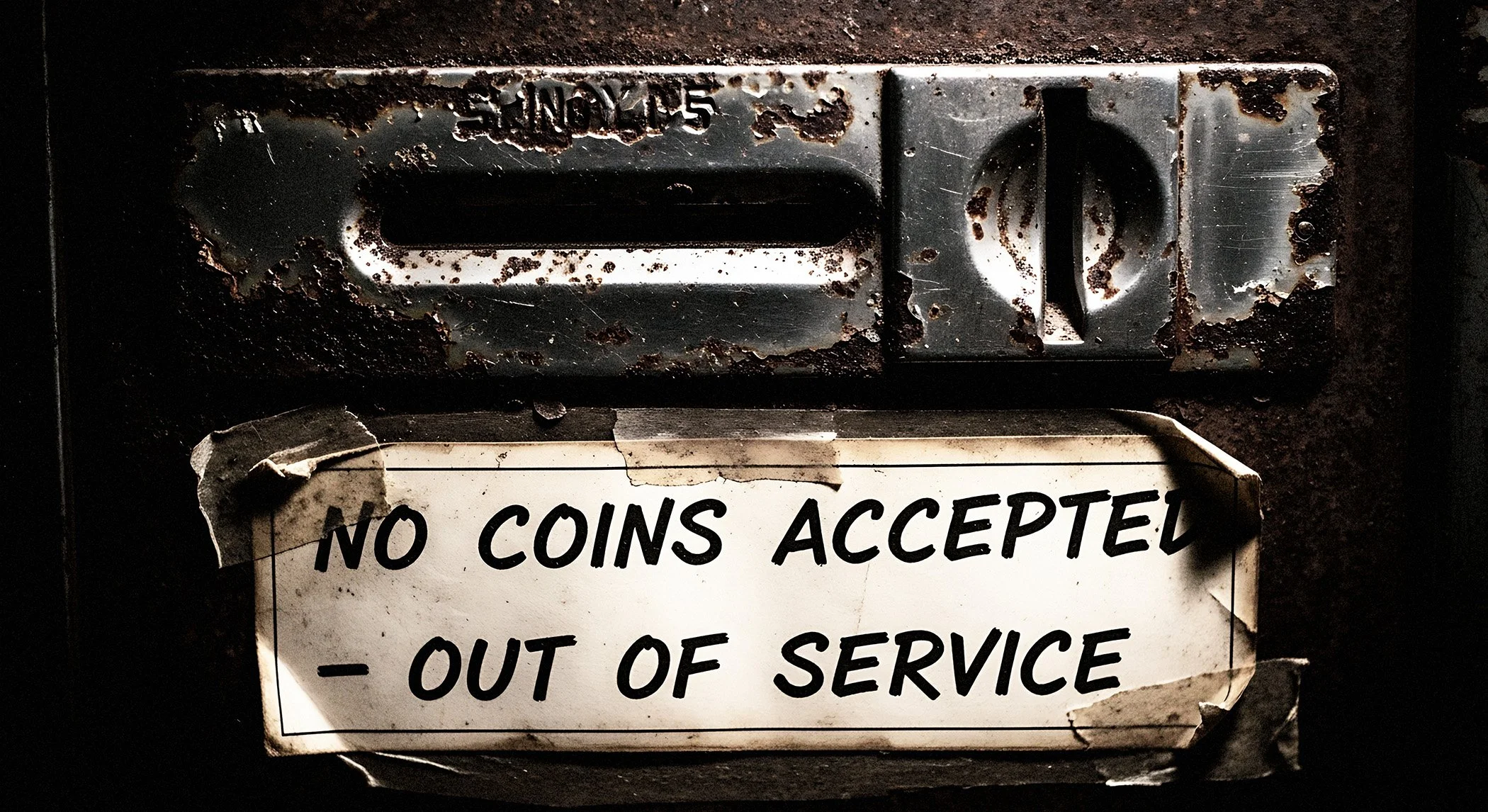
There is a difference between exchange and scaled extraction.
The problem is not that humans exchange with the world.
Life is exchange.
Breath is exchange.
Eating is exchange.
Metabolism is exchange.
Water crosses membranes. Oxygen crosses into blood. Minerals move through soil, roots, food, tissue. Microbes live across and within the perimeter we call a body.
Nothing alive exists by refusing contact.
A living form takes in, transforms, releases, returns.
The problem begins when exchange scales into extraction while the extractor imagines itself outside the field of consequence.
That is a different architecture.
A vending machine offers the fantasy perfectly.
Stand in front of it.
Insert value.
Press a button.
Receive what you selected.
Leave.
The interface is clean because nearly everything that made the object possible has disappeared behind the panel.
You do not see where the material came from.
You do not see what powered its production.
You do not see what was removed to make it available.
You do not see what happens after the wrapper leaves your hand.
The machine presents availability without origin.
And because the transaction closes cleanly, it can appear that the system has closed with it.
It has not.
The coin fell.
The coil turned.
The button offered no origin.
The exchange still required a return path.
The Erased Return Path
A living system does not operate like a vending machine.
It cycles.
Material enters one form and leaves another. Waste in one layer becomes substrate in another. Bodies die. Matter changes custody. Soil metabolizes what falls back into it. Water moves. Carbon moves. Nitrogen moves. Energy enters through forms capable of capturing it and travels through bodies that could never produce it alone.
The living world is not a warehouse containing discrete resources waiting for withdrawal.
It is an active network of transformation.
That distinction matters because extraction can look like exchange while quietly removing the return path from the operating picture.
The transaction may still contain two directions:
money goes in
product comes out
But payment is not ecological return.
The coin is not decomposition.
The invoice is not soil metabolism.
A market can settle the price of wood without rebuilding a forest.
It can settle the price of grain without restoring topsoil.
It can settle the price of water without replenishing an aquifer.
Economic closure and material closure are not the same event.
The vending-machine interface hides that difference because the user encounters the finished object at the point of availability.
Everything before the button becomes supply chain.
Everything after the button becomes disposal.
The middle becomes consumption.
And the return path disappears.
Not from reality.
From the model.
That is the distortion.
Exchange Is Not Innocence
None of this requires the fantasy that nature exists without taking.
Life consumes life.
Roots draw minerals.
Animals eat plants.
Animals eat animals.
Organisms compete for space, light, water, food, heat, shelter.
There is no pristine ecological morality in which nothing removes anything from anything else.
The distinction is not:
nature good
humans bad
Nor is it:
taking bad
leaving untouched good
The question is structural.
What kind of relation does the taking occur inside?
Exchange remains embedded in dependency.
Extraction can be organized as though dependency were optional.
That is where scale changes the geometry.
Scale is not automatically extraction. A large system can still preserve the conditions that sustain it. A small action can still be extractive.
But scale increases the capacity to move origin, cost, depletion, waste, and consequence away from the point of use.
Distance enters.
Throughput increases.
Specialization fragments visibility.
Supply chains lengthen.
Waste moves elsewhere.
Ownership separates from place.
Price becomes legible while replenishment becomes abstract.
The more sophisticated the interface becomes, the easier it is to confuse not seeing the return path with not having one.
Insulation Is Not Exteriority
Modern systems are extraordinarily good at insulation.
Walls insulate bodies from temperature.
Pipes move waste out of sight.
Refrigeration interrupts season.
Shipping separates consumption from origin.
Finance converts different materials, landscapes, labor systems, and time horizons into numbers that can be compared on one screen.
Cities allow millions of people to live at extraordinary distance from the visible processes sustaining them.
None of this is unreal.
Infrastructure genuinely changes what reaches a body and when.
Wealth can buffer consequence.
Geography can displace consequence.
Technology can postpone consequence.
Power can move consequence onto someone else.
But insulation is not exteriority.
A cost moved elsewhere has not ceased to exist.
A polluted river moved downstream is still a river.
Carbon moved into the atmosphere has not left the system.
Waste buried beneath land has not entered nonexistence.
And the human body has not become a remote avatar because the interface became elegant.
It still breathes.
It still drinks.
It still requires a narrow temperature range.
It still metabolizes food built through systems it did not invent.
It still depends on microbial worlds it does not control.
It still receives material from processes that extend far beyond the visible perimeter of the self.
The abstraction can obscure participation.
It cannot terminate it.
The Body Ruins the Pyramid
The ego pyramid says:
human at the top
everything else below
world as resource
body as consumer
But the material receipt is less flattering.
The atmosphere treated as an emissions sink is also entering lungs.
Water treated as industrial input is also entering tissue.
Soil treated as production substrate is also participating in food.
Microbes treated as background life are also living within the human organism.
Nearly every calorie arrives downstream of energy captured by forms the body cannot replace.
The body keeps ruining the fantasy of separation.
You can construct an economy that treats Earth as inventory.
You cannot construct a human body that no longer requires air.
You can price water.
You cannot substitute the price for hydration.
You can own land.
You cannot eat a deed.
You can build a model in which soil appears only as an agricultural variable.
The body will still require what grows through it.
The supposed sovereign consumer remains materially entangled with what the consumer model places outside itself.
The body is not standing in front of the system.
It is one of the forms being sustained inside it.
Saviorhood Keeps the Same Geometry
This is why “save the planet” can quietly preserve the structure it claims to correct.
First:
human above world as owner
Then:
human above world as destroyer
Then:
human above world as savior
The moral costume changes.
The geometry does not.
The planet does not need human centrality with a kinder job description.
The first correction is positional.
We are not standing outside a damaged object deciding whether to rescue it.
We are participants inside material systems whose conditions also pass through us.
Stewardship can be useful where it names responsibility.
But stewardship becomes another pyramid when the steward still imagines the world as a passive object beneath human jurisdiction.
The deeper correction is not nobility.
It is the end of imagined externality.
The Transaction Is Smaller Than the System
This is where the vending machine becomes dangerous as a worldview rather than a convenience.
The machine teaches a tiny but powerful grammar:
I want.
I pay.
I receive.
Done.
Within its proper scale, there is nothing remarkable about that transaction.
The distortion begins when this grammar becomes the template for relation with living systems.
Forest becomes timber.
River becomes supply.
Animal becomes unit.
Soil becomes yield.
Atmosphere becomes sink.
Land becomes asset.
The names are not always false.
The compression is.
Each term isolates one usable function and quietly suppresses the rest of the system required to keep that function available.
A forest can produce timber.
It is not therefore exhausted by timber.
A river can supply water.
It is not therefore reducible to supply.
Soil can produce crops.
It is not therefore equivalent to yield.
The transaction names what can be taken.
The system includes what makes taking possible.
Those are not the same perimeter.
Where Is Your Return Path?
The vending machine only appears to move in one direction:
outward.
Product toward user.
Resource toward consumer.
Availability toward demand.
But living systems do not survive indefinitely under a one-way model.
Where is your return path?
Where is your soil metabolism?
Where does the material go after use?
What is restored?
What is transformed?
What remains available to the system that made extraction possible?
What has simply been displaced beyond the frame?
The return path does not have to resemble repayment.
A forest does not require coins.
A watershed does not invoice.
Soil does not negotiate.
The point is not moral reciprocity between a person and a personified Earth.
The point is whether the material architecture remains capable of continuing.
Can the relation continue through repeated contact without destroying the conditions carrying it?
If not, the transaction may still succeed.
The extraction may still be profitable.
The product may still arrive.
The machine may still dispense.
For a while.
You Cannot Step Outside the System
The delusion is that we stand above the field we are extracting from.
That Earth is a machine dispensing resources.
That the body is a consumer positioned outside the circuitry.
But source and recipient were never outside the same material system.
The human organism remains inside the same material consequence it abstracts.
We were never outside the system.
We only built interfaces sophisticated enough to pretend we were.
And no degree of abstraction changes the underlying architecture:
the body still breathes through the atmosphere it alters
still drinks from the water cycle it modifies
still eats through biological systems it compresses into supply
still returns material whether the economic model records that return or not
The transaction can forget the loop.
The organism cannot cease participating in it.
The correction, then, is not purity.
Not guilt.
Not human self-hatred.
Not the fantasy of withdrawing from exchange.
Life is exchange.
The question is whether exchange remains capable of carrying a return path, or whether extraction has erased that path from the model while continuing to depend on the system it excludes.
The vending machine says:
press button. receive object. transaction complete.
The living world says nothing.
It continues operating according to conditions no interface can repeal.
You cannot step outside the system you are extracting from.
Final Finding
Gemini 5x, still in the river:
“SO THE VIBES FAILED?”
Cap Moon:
“No.
The plank failed.”
Can the sentence survive contact with load?
If yes, keep it.
If no, Gemini gets wet.